Herbs That Interact With Blood Thinners

If you take a blood thinner, your care team has probably told you to watch what you eat and to be careful with over-the-counter pain relievers. Fewer people are told, clearly, that several popular herbal supplements can also matter. Some may add to bleeding risk; at least one can make a blood thinner work less well.
This guide covers the herbs most often flagged with blood thinners, what reputable sources actually say about each, and how to talk to your pharmacist about them.
Educational notice: this article is for general education and is not medical advice. Do not start, stop or change any medication or supplement without talking to your doctor or pharmacist.
Why Blood Thinners and Herbs Need Extra Care
"Blood thinner" covers two main groups: anticoagulants such as warfarin, heparin and newer oral anticoagulants, and antiplatelet drugs such as aspirin and clopidogrel. Both are dosed to strike a balance between preventing clots and avoiding bleeding.
Herbs can disturb that balance in two directions:
- Adding to the effect, for example if a supplement also affects bleeding.
- Reducing the effect, for example if an herb speeds up how fast the body clears the drug.
The FDA warns that warfarin, ginkgo biloba, aspirin and vitamin E taken together "may increase the potential for internal bleeding or stroke" (FDA: Mixing Medications and Dietary Supplements Can Endanger Your Health). And MedlinePlus names coenzyme Q10, echinacea, garlic, ginkgo biloba, ginseng, goldenseal and St. John's wort as nonprescription or herbal products that may interact with warfarin, noting that some "may increase the risk for bleeding" (MedlinePlus: Warfarin).
Herbs Commonly Flagged With Blood Thinners
Ginkgo
NCCIH states that ginkgo "may increase the risk of bleeding in people who are taking anticoagulant drugs, such as warfarin" (NCCIH: Ginkgo). NCCIH's clinician digest adds that ginkgo with warfarin has been "associated with increased risk for major bleeding events compared to warfarin alone" (NCCIH: Herb-Drug Interactions).
Evidence is not uniform: a small controlled study in 12 healthy men found that ginkgo at recommended doses did not significantly change warfarin levels or INR over the study period (Jiang et al., Br J Clin Pharmacol, 2005). Healthy volunteers taking a single warfarin dose are not the same as patients on long-term therapy, which is why caution remains the standard advice.
Garlic supplements
NCCIH says "taking garlic supplements may increase the risk of bleeding" and that people taking anticoagulants or aspirin should be careful, since those medicines "may also affect bleeding" (NCCIH: Garlic). The concern is with concentrated supplements; tell your provider about them, especially before surgery.
Ginger
NCCIH's ginger page does not name a specific blood-thinner interaction, but advises talking with your provider before using ginger with any medicine (NCCIH: Ginger). In the same 2005 controlled study, ginger at recommended doses did not significantly affect warfarin levels or INR in healthy volunteers (Jiang et al., 2005). Many herbal references still flag ginger, especially at higher doses and in combination with other herbs that may affect bleeding.
Turmeric
Human evidence for turmeric is mixed: a small 10-day study of one curcumin formulation found no significant change in INR or bleeding time in stable patients (Hu et al., 2018), while rat studies show curcumin can raise warfarin blood levels (Liu et al., 2013). See our full guide: Turmeric and Blood Thinners.
Asian ginseng
NCCIH notes that Asian ginseng "may worsen autoimmune disorders and interfere with blood clotting," and that it "might interact with certain medications" (NCCIH: Asian Ginseng). MedlinePlus lists ginseng among products that may interact with warfarin.
St. John's wort: the opposite problem
St. John's wort tends to weaken warfarin rather than strengthen it. NCCIH lists warfarin among medicines whose effects it can weaken (NCCIH: St. John's Wort), and a controlled study found it increased warfarin clearance and reduced the INR response in healthy volunteers (Jiang et al., 2004). Less effect from an anticoagulant can mean a higher risk of clots. More detail: St. John's Wort Drug Interactions.

Combinations Add Up
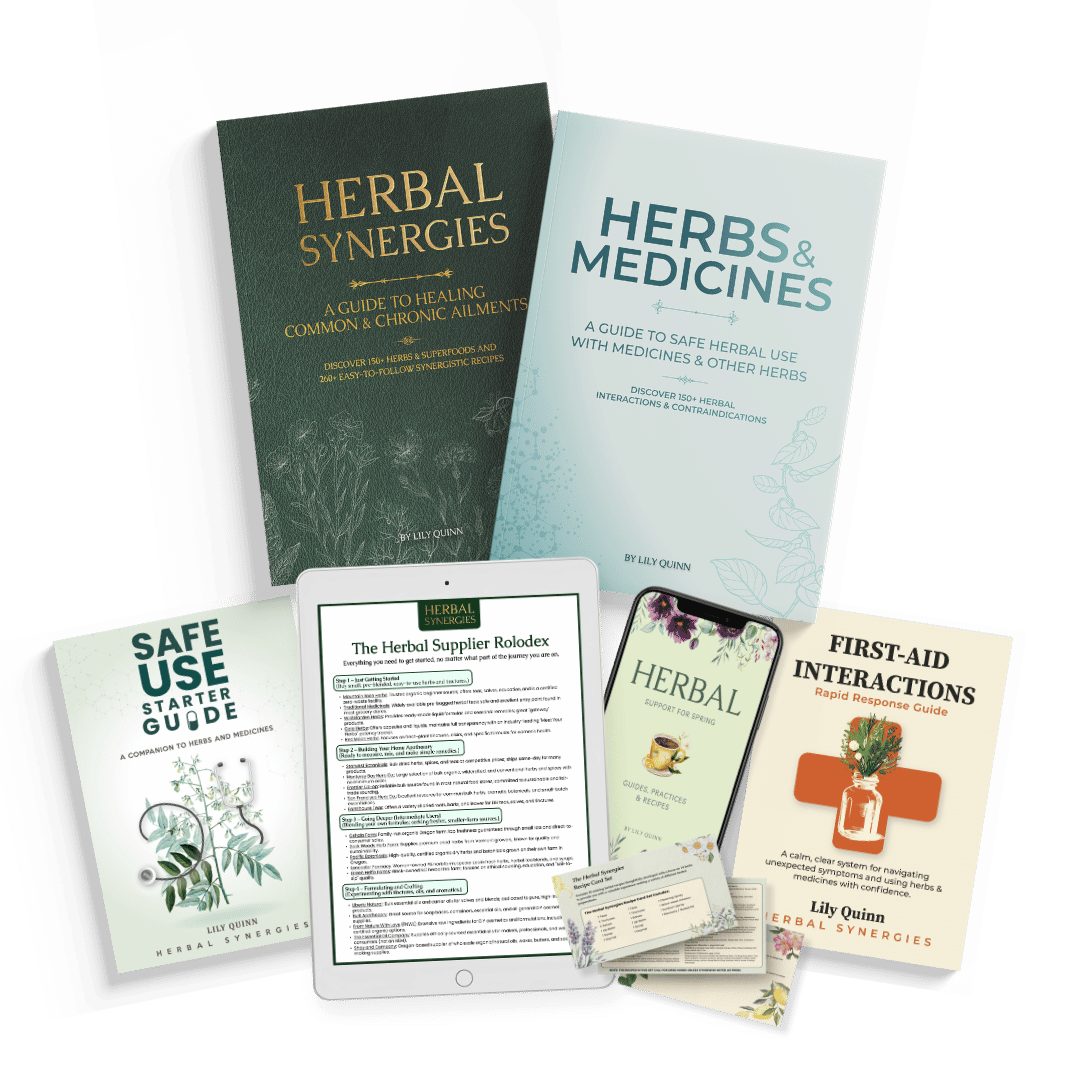
Many people take more than one supplement. Herbal references often flag herb-to-herb combinations as well as herb-to-drug ones. In Herbs & Medicines, for example:
- The garlic page lists blood thinners (warfarin, fluindione) and platelet inhibitors (aspirin, clopidogrel) among medications, and ginkgo biloba, ginger, willow bark, turmeric and feverfew among herbs, not to combine it with.
- The ginger page lists blood thinners (warfarin, heparin) and the herbs garlic, ginkgo biloba, turmeric/curcumin, feverfew and danshen.
- The ginkgo page lists blood thinners (warfarin, heparin, aspirin) and the herbs garlic supplements, high-dose ginger, ginseng, St. John's wort and willow bark.
Notice how the same names recur. Someone taking garlic capsules, ginkgo and a turmeric supplement alongside a blood thinner is stacking several items that references flag together.
Look up herb-to-herb and herb-to-drug flags in one place. Herbs & Medicines profiles 150 herbs and lists, for each, the medications and other herbs to keep it apart from. See Herbs & Medicines.
How to Talk to Your Pharmacist
- Bring a complete list of every supplement, herb, vitamin and over-the-counter product, with doses.
- Ask about each one specifically with your blood thinner, and about the combination as a whole.
- Ask whether extra monitoring (for example, INR checks on warfarin) makes sense if you start or stop anything.
- Plan for procedures. The FDA notes providers may ask you to stop dietary supplements two or three weeks before surgery (FDA).
- Do not stop or adjust your blood thinner to "make room" for a supplement.

Why the Evidence Looks Inconsistent
It can be confusing that a small study finds "no significant effect" while official sources still advise caution. There are good reasons for both to be true. Controlled studies often use healthy volunteers, a single dose of the blood thinner and one product of known quality for a short time. Real-world users may be older, take several medicines, use different products and doses, and take them for months. Rare bleeding events are also hard to detect in a dozen volunteers. Caution is the reasonable default until the evidence for your specific situation is clear.
Know the Warning Signs
MedlinePlus lists signs to report right away for anyone on warfarin, including bleeding that won't stop, nosebleeds, bleeding gums, pink, red or dark brown urine, red or tarry black stools, coughing or vomiting blood, and easy bruising (MedlinePlus: Warfarin). Seek care promptly if they occur.

Frequently Asked Questions
Are cooking amounts of garlic and ginger a problem?
Sources focus mainly on concentrated supplements. Still, mention significant dietary changes to your care team, particularly with warfarin, where MedlinePlus also advises keeping vitamin K intake consistent.
Does this apply to daily low-dose aspirin?
Yes. NCCIH specifically mentions aspirin in its garlic caution, and the FDA names aspirin with ginkgo in its bleeding warning.
The Takeaway
Ginkgo, garlic supplements, ginseng, turmeric and ginger are among the herbs most often flagged with blood thinners, while St. John's wort can weaken warfarin. The evidence varies from herb to herb, which is exactly why a pharmacist review of your full list is the safe default. To prepare for that conversation, keep a reference like Herbs & Medicines on hand.
Sources
- U.S. FDA. Mixing Medications and Dietary Supplements Can Endanger Your Health. fda.gov
- MedlinePlus. Warfarin. medlineplus.gov
- NCCIH. Ginkgo. nccih.nih.gov
- NCCIH. Herb-Drug Interactions: What the Science Says. nccih.nih.gov
- Jiang X, et al. Effect of ginkgo and ginger on the pharmacokinetics and pharmacodynamics of warfarin in healthy subjects. Br J Clin Pharmacol. 2005;59(4):425-32. PubMed 15801937
- NCCIH. Garlic. nccih.nih.gov
- NCCIH. Ginger. nccih.nih.gov
- Hu S, et al. Eur Rev Med Pharmacol Sci. 2018;22(15):5042-5046. PubMed 30070343
- Liu AC, et al. Planta Med. 2013;79(11):971-7. PubMed 23807811
- NCCIH. Asian Ginseng. nccih.nih.gov
- NCCIH. St. John's Wort. nccih.nih.gov
- Jiang X, et al. Effect of St John's wort and ginseng on the pharmacokinetics and pharmacodynamics of warfarin. Br J Clin Pharmacol. 2004;57(5):592-9. PubMed 15089812
Disclaimer: This article is for educational purposes only and is not intended to diagnose, treat, cure or prevent any disease. It is not a substitute for professional medical advice. Always consult your doctor or pharmacist before starting, stopping or combining any herb, supplement or medication. Statements about herbs have not been evaluated by the Food and Drug Administration.
This article is educational and is not a substitute for individualized medical or medication guidance from your physician, pharmacist, or other healthcare professional. Herbs can interact with medications and with each other; always confirm anything new with your provider. These statements have not been evaluated by the Food and Drug Administration.
How we research and review
Guides in the Herbal Reference Library draw on the same reference system as our books, which point to more than 500 scientific citations readers can check for themselves. Every recommendation is framed as support for everyday wellness, never as a treatment or a cure, and safety notes direct readers to confirm combinations with their own healthcare professional.
The Herbal Synergies Research Team compiles and reviews every guide in the Herbal Reference Library, drawing on published research, recognized herbal monographs, and current medication references. Our guides are written to support everyday wellness and always point you back to a qualified healthcare professional before you combine anything new.