St. John's Wort Drug Interactions: What to Know

Among all the herbs people take on their own, St. John's wort has some of the best-documented medication interactions. The NCCIH puts it bluntly: St. John's wort "can interact in dangerous, sometimes life-threatening ways with a variety of medicines" (NCCIH: St. John's Wort). Yet it is sold over the counter, often next to vitamins, with little on the label to signal how many prescriptions it can affect.
This guide explains which medicines are involved, why the herb has this effect, and what to ask your pharmacist before taking it.
Educational notice: this article is for general education and is not medical advice. Do not start, stop or change any medication or supplement without talking to your doctor or pharmacist.
Why St. John's Wort Interacts With So Many Medicines
Most herb-drug interactions fall into two families. Pharmacokinetic interactions change how much of a drug reaches and stays in your body. Pharmacodynamic interactions change what the drug does once it is there. (We explain both in Pharmacokinetic vs. Pharmacodynamic Herb Interactions.) St. John's wort is notable because it does both.
It speeds up the body's drug-clearing machinery
The NCCIH describes St. John's wort as "a potent inducer of both cytochrome P-450 enzymes and intestinal P-glycoprotein" (NCCIH: Herb-Drug Interactions, What the Science Says). Cytochrome P450 (CYP) enzymes in the liver and gut break down many medicines, and P-glycoprotein is a transporter that pumps some drugs back out of cells. When an herb "induces" these systems, the body clears certain drugs faster, so blood levels can fall and the medicine may work less well.
A landmark 2000 study in the Proceedings of the National Academy of Sciences showed that St. John's wort induces liver drug metabolism by activating the pregnane X receptor, a switch that turns on drug-metabolizing genes (Moore et al., PNAS, 2000).
It can add to serotonin effects
Separately, NCCIH warns that combining St. John's wort with certain antidepressants or other drugs that affect serotonin "may lead to increased serotonin-related side effects, which can be serious" (NCCIH). This is an effect-stacking (pharmacodynamic) concern rather than a drug-level one.
Medicines St. John's Wort Can Affect
NCCIH lists the following among medicines whose effects St. John's wort can weaken (NCCIH: St. John's Wort):
- Some antidepressants, including amitriptyline and bupropion
- Birth control pills
- Cyclosporine (used to prevent organ transplant rejection)
- Some seizure medicines, including phenytoin and carbamazepine
- Some heart medicines, including digoxin and ivabradine
- Some HIV medicines, including indinavir and nevirapine
- Some cancer medicines, including irinotecan, imatinib and docetaxel
- Warfarin, an anticoagulant
- Certain statins, including simvastatin
The FDA makes the same general point: some drugs "are less effective when taken with St. John's wort" (FDA). This is not a complete list. Because the herb affects pathways that process a large share of medicines, any prescription is worth checking.

Birth Control: Reduced Effectiveness
The contraceptive interaction is one of the most studied. In a 2005 study, 16 women taking a low-dose oral contraceptive added St. John's wort 300 mg three times daily. Researchers found a 13-15% reduction in exposure to the contraceptive hormones, more breakthrough bleeding, and evidence of follicle growth and probable ovulation. The authors concluded that women using oral contraceptives "should be cautioned that St. John's Wort might interfere with contraceptive effectiveness" (Murphy et al., Contraception, 2005).
A 2016 systematic review led by CDC researchers found that three studies showed increased breakthrough bleeding and three showed significantly decreased hormone exposure when combined oral contraceptives were taken with St. John's wort. The one study without significant pharmacokinetic changes used a product low in hypericin, suggesting the product itself matters (Berry-Bibee et al., Contraception, 2016).
Warfarin: Faster Clearance
In a crossover study in 12 healthy men, two weeks of St. John's wort increased the clearance of both forms of warfarin (by roughly 29% for S-warfarin and 23% for R-warfarin) and lowered the INR response compared with warfarin alone (Jiang et al., Br J Clin Pharmacol, 2004). For someone relying on warfarin to prevent clots, a weaker effect is the concern. MedlinePlus lists St. John's wort among the herbal products to tell your doctor about if you take warfarin (MedlinePlus: Warfarin).

Antidepressants: The Serotonin Concern
St. John's wort is often taken for mood, so it is frequently considered by people who already take, or are coming off, a prescription antidepressant. Combining them is exactly the scenario NCCIH highlights for serious serotonin-related side effects. Never combine or switch between them without your prescriber's direction.
What a Reference Page Looks Like for St. John's Wort
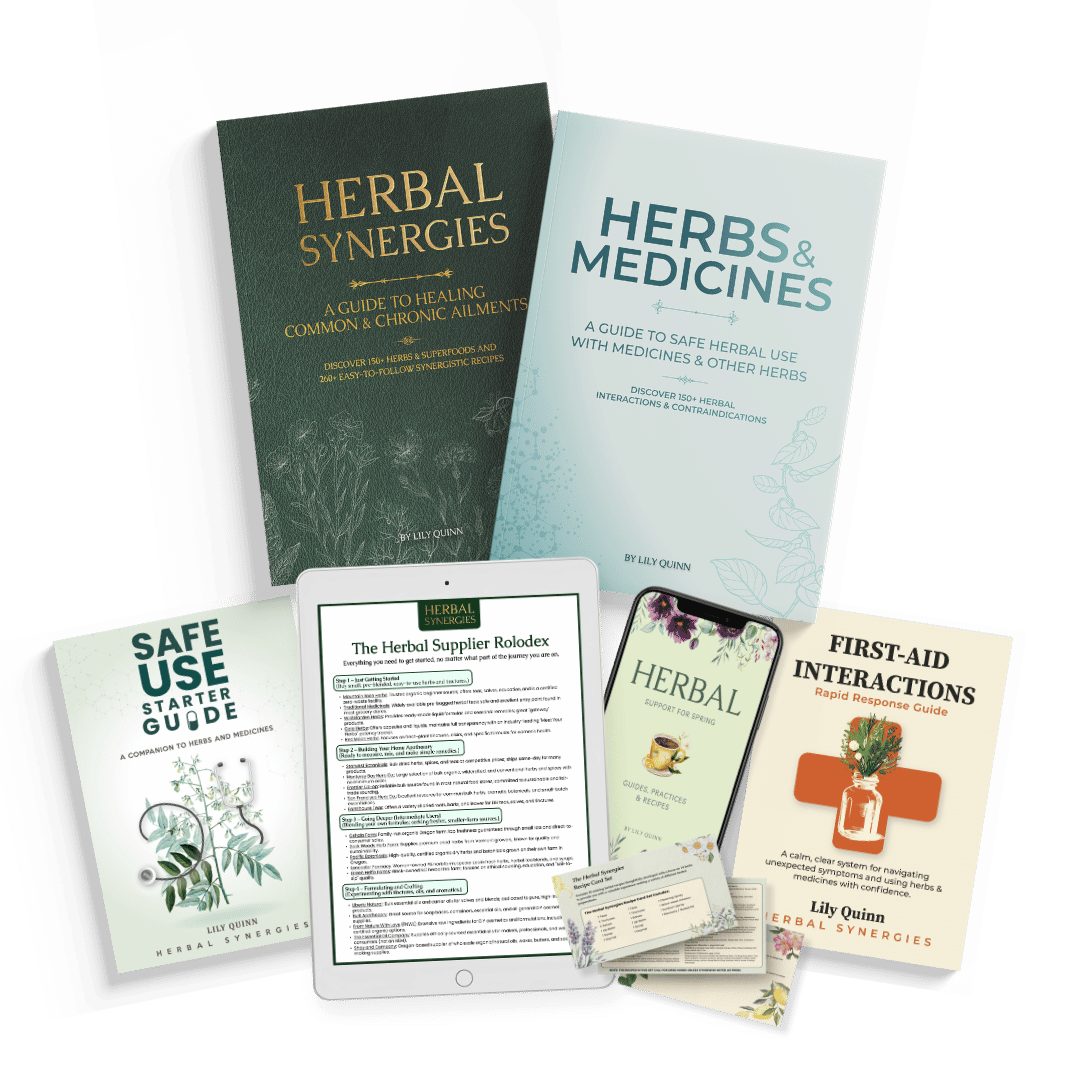
In Herbs & Medicines, the St. John's wort page lists the medications it should not be combined with: antidepressants (SSRIs, SNRIs), birth control pills, blood thinners (warfarin), heart medications (digoxin) and immunosuppressants (cyclosporine). It also lists herbs to keep apart from it: ginkgo biloba, valerian, kava, passionflower and copaiba oil. Several other pages in the book, including ashwagandha and valerian, list St. John's wort among their own contraindicated herbs.
Check before you combine. Herbs & Medicines gives each of its 150 herbs a page that lists the medications and other herbs to keep it apart from, so you can see at a glance what to ask your pharmacist about. Get Herbs & Medicines.

Practical Steps Before Taking St. John's Wort
- List everything you take, including prescriptions, over-the-counter medicines, vitamins and other herbs.
- Ask your pharmacist to check the list against St. John's wort specifically. They can see interactions your search engine cannot.
- Tell your prescriber before starting or stopping it. Because the herb changes drug levels, stopping it can matter too.
- If you use hormonal birth control, ask whether a backup or alternative method is needed.
- Before surgery, mention it. The FDA notes providers may ask you to stop dietary supplements two or three weeks before a procedure (FDA).
Stopping Matters Too
Because St. John's wort works by changing how fast the body clears certain medicines, the interaction does not only matter when you start it. If your medicine dose has been set while you were taking the herb, stopping it could change your drug levels again. That is why any start, stop or switch should be coordinated with your prescriber and pharmacist.
Frequently Asked Questions
Is St. John's wort dangerous for everyone?
No. The concern is mainly for people taking other medicines. But because the list of affected medicines is long, it is one herb where checking first really matters.
Does the brand or product matter?
It can. The 2016 review found that a low-hypericin product did not show the same pharmacokinetic changes, which suggests that product composition affects the size of the interaction. Your pharmacist can help you interpret a specific label.
Can I take St. John's wort a few hours apart from my medicine?
Spacing doses does not solve an enzyme-induction interaction, because the effect on drug-clearing enzymes builds up over time rather than happening only in the gut at the moment you swallow.
The Takeaway
St. John's wort is a textbook example of why "natural" does not mean "interaction-free." It can lower the effectiveness of birth control, warfarin, transplant drugs, some heart, HIV, seizure and cancer medicines, and it can add to serotonin effects with antidepressants. If you take any prescription, talk to your doctor or pharmacist first. A good reference, such as Herbs & Medicines, helps you walk into that conversation with the right questions.
Sources
- NCCIH. St. John's Wort. Last updated May 2025. nccih.nih.gov/health/st-johns-wort
- NCCIH. Herb-Drug Interactions: What the Science Says. nccih.nih.gov
- Moore LB, et al. St. John's wort induces hepatic drug metabolism through activation of the pregnane X receptor. Proc Natl Acad Sci USA. 2000. PubMed 10852961
- U.S. FDA. Mixing Medications and Dietary Supplements Can Endanger Your Health. fda.gov
- Murphy PA, et al. Interaction of St. John's Wort with oral contraceptives. Contraception. 2005;71(6):402-8. PubMed 15914127
- Berry-Bibee EN, et al. Co-administration of St. John's wort and hormonal contraceptives: a systematic review. Contraception. 2016;94(6):668-677. PubMed 27444983
- Jiang X, et al. Effect of St John's wort and ginseng on the pharmacokinetics and pharmacodynamics of warfarin in healthy subjects. Br J Clin Pharmacol. 2004;57(5):592-9. PubMed 15089812
- MedlinePlus. Warfarin. medlineplus.gov
Disclaimer: This article is for educational purposes only and is not intended to diagnose, treat, cure or prevent any disease. It is not a substitute for professional medical advice. Always consult your doctor or pharmacist before starting, stopping or combining any herb, supplement or medication. Statements about herbs have not been evaluated by the Food and Drug Administration.
This article is educational and is not a substitute for individualized medical or medication guidance from your physician, pharmacist, or other healthcare professional. Herbs can interact with medications and with each other; always confirm anything new with your provider. These statements have not been evaluated by the Food and Drug Administration.
How we research and review
Guides in the Herbal Reference Library draw on the same reference system as our books, which point to more than 500 scientific citations readers can check for themselves. Every recommendation is framed as support for everyday wellness, never as a treatment or a cure, and safety notes direct readers to confirm combinations with their own healthcare professional.
The Herbal Synergies Research Team compiles and reviews every guide in the Herbal Reference Library, drawing on published research, recognized herbal monographs, and current medication references. Our guides are written to support everyday wellness and always point you back to a qualified healthcare professional before you combine anything new.