Licorice Root and Blood Pressure: The Tea That Can Work Against Your Pill

Here is a story we hear in different versions all the time. A mom in her sixties is doing everything right. She takes her blood pressure pill every morning, she cut back on salt, and she swapped her evening glass of wine for a soothing "throat comfort" herbal tea. Three or four cups a day, because it tastes lovely and feels like self-care. Then, at her next checkup, her blood pressure is higher than it has been in years, and her doctor is puzzled.
Nobody asks about the tea. Why would they? It is just tea.
But many throat and digestive teas contain licorice root, and licorice root contains a compound that can push blood pressure up and pull potassium down. This article walks through what the research and federal health agencies say about licorice, who should be careful, and what to check on the box.
Educational notice: this article is for general education and is not medical advice. Do not start, stop or change any medication, tea or supplement without talking to your doctor or pharmacist.
Licorice Is Not Just Candy
Licorice root (Glycyrrhiza glabra) has a long traditional history and shows up today in herbal teas, lozenges, supplements and some candies. Its sweetness comes largely from a compound called glycyrrhizin. The U.S. National Center for Complementary and Integrative Health (NCCIH) puts it plainly: "Licorice contains a component called glycyrrhizin, or glycyrrhizic acid, that can cause serious adverse effects" (NCCIH: Licorice Root).
How Licorice Can Raise Blood Pressure
The mechanism is surprisingly elegant. Your kidneys use an enzyme called 11β-HSD2 to switch off cortisol before it can act on a receptor that controls salt and water balance. A 2021 review in Frontiers in Nutrition explains that "glycyrrhizin metabolites inhibit type 2 11β-hydroxysteroid dehydrogenase (11βHSD2)," which "results in a higher concentration of cortisol that binds to and stimulates the mineralocorticoid receptor" (Yoshino et al., Front Nutr, 2021).
In plain English: licorice can make the body behave as if it has too much of a salt-retaining hormone, even though it does not. Doctors call this pseudoaldosteronism. The same review describes it as "characterized by peripheral edema, hypertension, laboratory hypokalemia, and lower plasma renin activity," and warns that "some cases can progress to severe hypokalemia and life-threatening arrhythmia."
Hypokalemia means low potassium. Potassium helps keep the heart's rhythm steady, which is why this matters so much for anyone who already has a heart or blood pressure condition.

Who Is Most at Risk?
NCCIH notes that even small amounts of glycyrrhizin have been linked to severe effects in people with hypertension, especially those who eat a lot of salt, and that risk is also higher "in people with heart or kidney conditions" (NCCIH).
The Frontiers in Nutrition review lists several risk factors identified in the research (Yoshino et al., 2021):
- Daily dose: more licorice per day means more risk.
- Duration: "Long-term use (>30 days) is also an important factor."
- Older age: "Older age is associated with reduced 11βHSD2 function."
- Female sex: proposed as a risk factor in the literature.
- Certain medicines: "Concomitant use of medications, including antihypertensives, especially thiazide, loop diuretics" raises the risk.
That last point is the one that should make every reader on a water pill pause. Thiazide and loop diuretics already tend to lower potassium. Licorice can lower it further. Two things that each nudge potassium down can add up to a much bigger drop.
A Real Case: The Throat Tea
A 2025 case report in Cureus describes a woman in her 70s who drank five to six cups a day of a commercially available throat-soothing herbal tea for six to eight weeks. Each tea bag contained 820 mg of licorice root. Her potassium dropped to 2.0 mEq/L, a dangerously low level, and she needed hospital treatment before it returned to normal. The authors wrote that "licorice toxicity is notable but often overlooked" (Saha et al., Cureus, 2025).
Her situation was complicated by other illnesses and medicines, so one case does not tell us what will happen to anyone else. But it captures the pattern perfectly: an ordinary, comforting tea, taken generously and daily, by someone nobody thought to ask about it.

The Medicines Licorice Is Known to Clash With
NCCIH reports that "interactions between licorice and corticosteroids have been reported," and recommends talking with a health care provider before using licorice if you take any medicine (NCCIH).
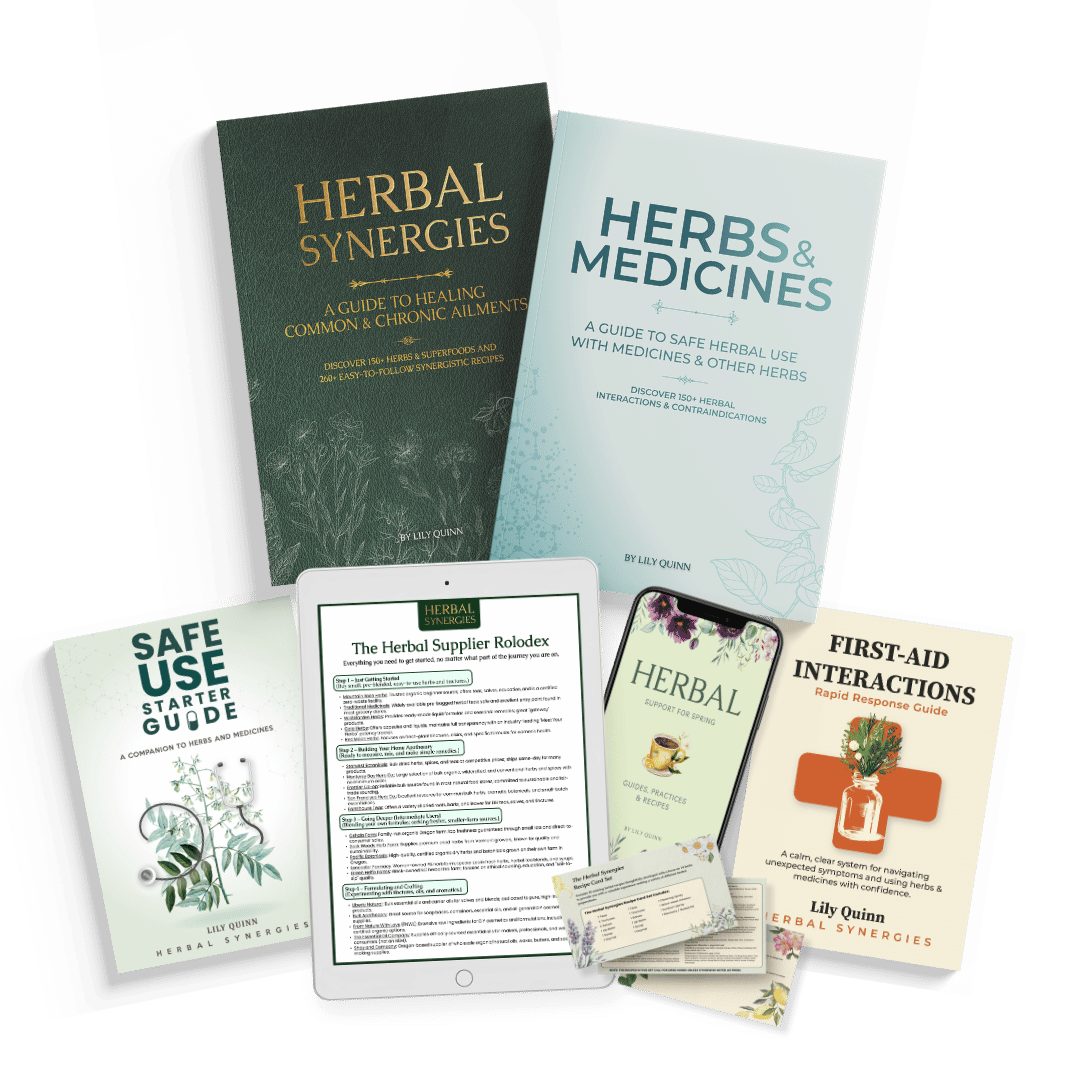
In the Herbs & Medicines reference, the Licorice Root page lists five medication groups not to combine it with: blood thinners (warfarin), diuretics (water pills), blood pressure medications (Aldactone), heart medications (digoxin), and corticosteroids (prednisone). The same page lists five herbs it flags in combination: epazote, horsetail, ginseng, dandelion and hawthorn.
Look at that herb list through the "stacking" lens. Dandelion and horsetail are traditional "water" herbs, and hawthorn is a traditional heart herb. Someone trying to support their heart naturally could easily end up with a tea blend, a capsule and a prescription all pulling on the same system at once.
Is There a Safer Form?
Yes, at least on paper. Some licorice products have the glycyrrhizin removed. NCCIH states that "oral licorice products that do not contain glycyrrhizin (deglycyrrhizinated licorice) might be safe for up to 4 months" (NCCIH). These are usually labeled DGL.
Two cautions. First, "might be safe" is not the same as "safe for you," especially if you take blood pressure or heart medicines. Second, many teas simply list "licorice root" without saying how much glycyrrhizin is present. If the box does not say deglycyrrhizinated, assume it is not.
NCCIH also warns that consuming large amounts of licorice extract during pregnancy is unsafe and may increase the risk of early delivery.

What to Check Before Your Next Cup
- Read the tea box. Look for licorice root, Glycyrrhiza, or "sweet root" in throat, digestive, detox and "sweet" herbal blends.
- Count the cups. The research points to daily dose and duration as key risk factors.
- Know your medicines. Water pills, blood pressure medicines, digoxin and steroids deserve a specific question to your pharmacist.
- Watch for warning signs. New swelling, muscle weakness or an irregular heartbeat are reasons to call your doctor.
- Bring the box. Show your doctor or pharmacist the actual product, not just the name.
Frequently Asked Questions
Can licorice tea raise blood pressure?
It can. Glycyrrhizin in licorice root can cause a pseudoaldosteronism pattern that includes high blood pressure and low potassium, and published cases include people who drank licorice-containing herbal tea daily (Saha et al., 2025).
Is it safe with blood pressure medication?
Ask your prescriber. Research lists antihypertensives and thiazide or loop diuretics as factors that increase the risk of licorice-related problems (Yoshino et al., 2021).
Does the effect go away?
According to the same review, "most cases of licorice-induced PsA are self-limiting and are resolved once licorice intake ceases," although a minority become severe. Never treat symptoms on your own; get medical help.
Is DGL licorice different?
Yes. Deglycyrrhizinated licorice has the glycyrrhizin removed, and NCCIH says it might be safe for up to four months. Still check with your pharmacist if you take heart or blood pressure medicines.
The Takeaway
Licorice root is a good reminder that "gentle" and "harmless" are different words. A daily tea can act on the same systems your blood pressure medicine is trying to control, and the people most likely to reach for a comforting cup are often the people most likely to be on a water pill. Read the box, count the cups, and bring it to your next appointment.
If you or someone you care for takes a daily heart or blood pressure medicine, Herbs & Medicines shows, herb by herb, which medications and other herbs each one should not be combined with, so the "just tea" question never slips through the cracks again.
Sources
- NCCIH. Licorice Root. nccih.nih.gov/health/licorice-root
- Yoshino T, Shimada S, Homma M, Makino T, Mimura M, Watanabe K. Clinical Risk Factors of Licorice-Induced Pseudoaldosteronism Based on Glycyrrhizin-Metabolite Concentrations: A Narrative Review. Front Nutr. 2021;8:719197. PMID 34604277. PMC8484325
- Saha P, Aydin-Ghormoz E, Beers K, Abid S. A Case of Hypokalemia Caused by the Consumption of Licorice-Containing Herbal Tea. Cureus. 2025;17(6):e86154. PMC12266736
Disclaimer: This article is for educational purposes only and is not intended to diagnose, treat, cure or prevent any disease. It is not a substitute for professional medical advice. Always consult your doctor or pharmacist before starting, stopping or combining any herb, supplement or medication. Statements about herbs have not been evaluated by the Food and Drug Administration.
This article is educational and is not a substitute for individualized medical or medication guidance from your physician, pharmacist, or other healthcare professional. Herbs can interact with medications and with each other; always confirm anything new with your provider. These statements have not been evaluated by the Food and Drug Administration.
How we research and review
Guides in the Herbal Reference Library draw on the same reference system as our books, which point to more than 500 scientific citations readers can check for themselves. Every recommendation is framed as support for everyday wellness, never as a treatment or a cure, and safety notes direct readers to confirm combinations with their own healthcare professional.
The Herbal Synergies Research Team compiles and reviews every guide in the Herbal Reference Library, drawing on published research, recognized herbal monographs, and current medication references. Our guides are written to support everyday wellness and always point you back to a qualified healthcare professional before you combine anything new.