Is Comfrey Safe? Grandma's Knitbone and the 2001 FDA Warning

Ask anyone who grew up around a kitchen garden, and there is a good chance they remember comfrey. The big fuzzy leaves, the purple bell flowers, and a grandmother who called it "knitbone" and wrapped it around a twisted ankle. For generations it was the plant you reached for when something was bruised, sprained or slow to heal.
So it surprises people to learn that in 2001, the U.S. Food and Drug Administration advised supplement makers to pull comfrey products off the market. Both stories are true. Comfrey has a long traditional history, and it also contains compounds that can seriously damage the liver when taken by mouth. This article explains how both can be true at once, and why the way you use an herb can matter as much as which herb it is.
Educational notice: this article is for general education and is not medical advice. Do not use comfrey, or any herb, without talking to your doctor or pharmacist, especially if you take medication or have liver disease.
Where the "Knitbone" Name Comes From
Memorial Sloan Kettering Cancer Center's integrative medicine database lists "Knitbone" and "Bruisewort" among comfrey's common names, and notes that "comfrey leaves and roots have been used for many centuries for wound healing, inflammation, and other conditions" (MSK: Comfrey).
The same source is careful to add that these effects "have not been confirmed in humans through clinical trials." Preclinical work suggests comfrey may support callus formation, but human evidence for bone healing is lacking. Tradition tells us what people valued. It does not, on its own, tell us what is safe.
The Problem Hiding in the Leaf
Comfrey contains a family of compounds called pyrrolizidine alkaloids. MSK states that "comfrey contains unsaturated pyrrolizidine alkaloids, which are hepatotoxic, mutagenic, and carcinogenic," and that "cases of liver toxicity have been reported with use of comfrey." It adds that "hepatotoxicity with oral use of comfrey has been cited in the medical literature" (MSK).
Hepatotoxic means harmful to the liver. The medical literature MSK cites includes reports of hepatic veno-occlusive disease associated with comfrey ingestion, a condition in which small veins in the liver become blocked.

What Happened in 2001
According to MSK, "in 2001 the FDA... advised all dietary supplement manufacturers to remove products containing comfrey from the market" (MSK). The concern was oral products: teas, capsules and tablets that deliver the alkaloids directly to the digestive system and liver.
MSK also reports that several cases of accidental ingestion occurred when people drank what they thought was comfrey herbal tea. That is a second, quieter risk: when plants are misidentified or mixed up, the person drinking the tea has no idea what they are actually taking.
Oral vs. Topical: Why Form Matters
This is the heart of the comfrey story, and it is a lesson that applies far beyond comfrey. The same plant can carry very different risks depending on how it is prepared and used.
Traditional comfrey use was largely external: poultices, compresses, salves and creams on unbroken skin. MSK notes that "preliminary data on topical formulations suggest it may relieve pain," although a Cochrane review "did not find sufficient evidence for its use" for low back pain. The official warnings center on taking comfrey by mouth.
That does not make topical comfrey automatically safe for everyone. Broken skin, long-term use, pregnancy, breastfeeding and liver disease are all reasons to check with a professional first. But it does explain why one herbalist can talk warmly about a comfrey salve while a doctor warns sharply against comfrey tea. They may be talking about two very different exposures.
In the Herbal Synergies approach, this is the form and preparation question: it is not only which herb, but how. A tea, a capsule, a tincture and a salve are not interchangeable.

Comfrey and Medications
Because comfrey's main risk is to the liver, it makes sense to be extra careful about combining it with anything else the liver has to handle. In the Herbs & Medicines reference, the Comfrey page lists five medication groups not to combine it with: hepatotoxic drugs (acetaminophen, statins), blood thinners (warfarin, heparin), immunosuppressants (methotrexate, cyclosporine), alcohol and alcoholic medications, and chemotherapy drugs.
The same page flags five herbs: kava, chaparral, pennyroyal, germander and greater celandine. Several of these are herbs that have their own liver-safety concerns. For example, NCCIH notes that "various kava products have been linked to rare cases of liver injury, some of which have been serious or even fatal" (NCCIH: Kava). Stacking liver-stressing herbs on top of each other is a pattern worth avoiding.
MSK's advice to patients is simple: "Tell your healthcare providers about any dietary supplements you're taking." The FDA makes the same point more broadly, recommending that people bring "a list of all the dietary supplements and medications you are currently taking" to every medical visit (FDA).
There is a pattern worth noticing here. The herbs that most often get people into trouble are rarely the obscure ones. They are the familiar, trusted plants that feel like family, the ones nobody thinks to mention to a doctor because they never felt like "medicine" in the first place. Comfrey is a textbook example, and that familiarity is exactly why it deserves a second look.
How to Think About Inherited Remedies
Comfrey is a useful case study for any remedy passed down through a family. A few questions help separate what to keep from what to rethink:
- How was it actually used? On the skin, as a short course, or as a daily tea? The form changes the risk.
- What do current safety sources say? Check NCCIH, MedlinePlus or the FDA before relying on memory.
- What else is in the picture? Medicines, alcohol and other herbs that affect the same organ can change the answer.
- Who is using it? Pregnancy, breastfeeding, children, older adults and anyone with liver disease deserve extra caution.
- Is the plant correctly identified? Homegrown and foraged plants can be mistaken for look-alikes.

Frequently Asked Questions
Is comfrey tea safe to drink?
Comfrey contains pyrrolizidine alkaloids that are harmful to the liver, liver toxicity has been reported with oral use, and the FDA advised in 2001 that comfrey supplement products be removed from the market (MSK). Do not drink comfrey tea without medical advice.
Why is comfrey called knitbone?
The name reflects centuries of traditional use for bruises, sprains and broken bones. Human clinical trials have not confirmed those effects.
Is comfrey cream the same as comfrey tea?
No. The official safety concerns focus on oral use. Topical products may still be inappropriate for broken skin, long-term use, or people with liver disease, so ask a professional first.
Can I use comfrey if I take acetaminophen or a statin?
The Herbs & Medicines reference lists hepatotoxic drugs, including acetaminophen and statins, among the medications not to combine with comfrey. Talk to your doctor or pharmacist before using it.
The Takeaway
Comfrey is both a beloved traditional plant and an herb with a serious, well-documented warning on oral use. Those two facts do not cancel each other out; they point to the same lesson. Respect the tradition, check the current science, and pay close attention to how an herb is prepared and what it is combined with.
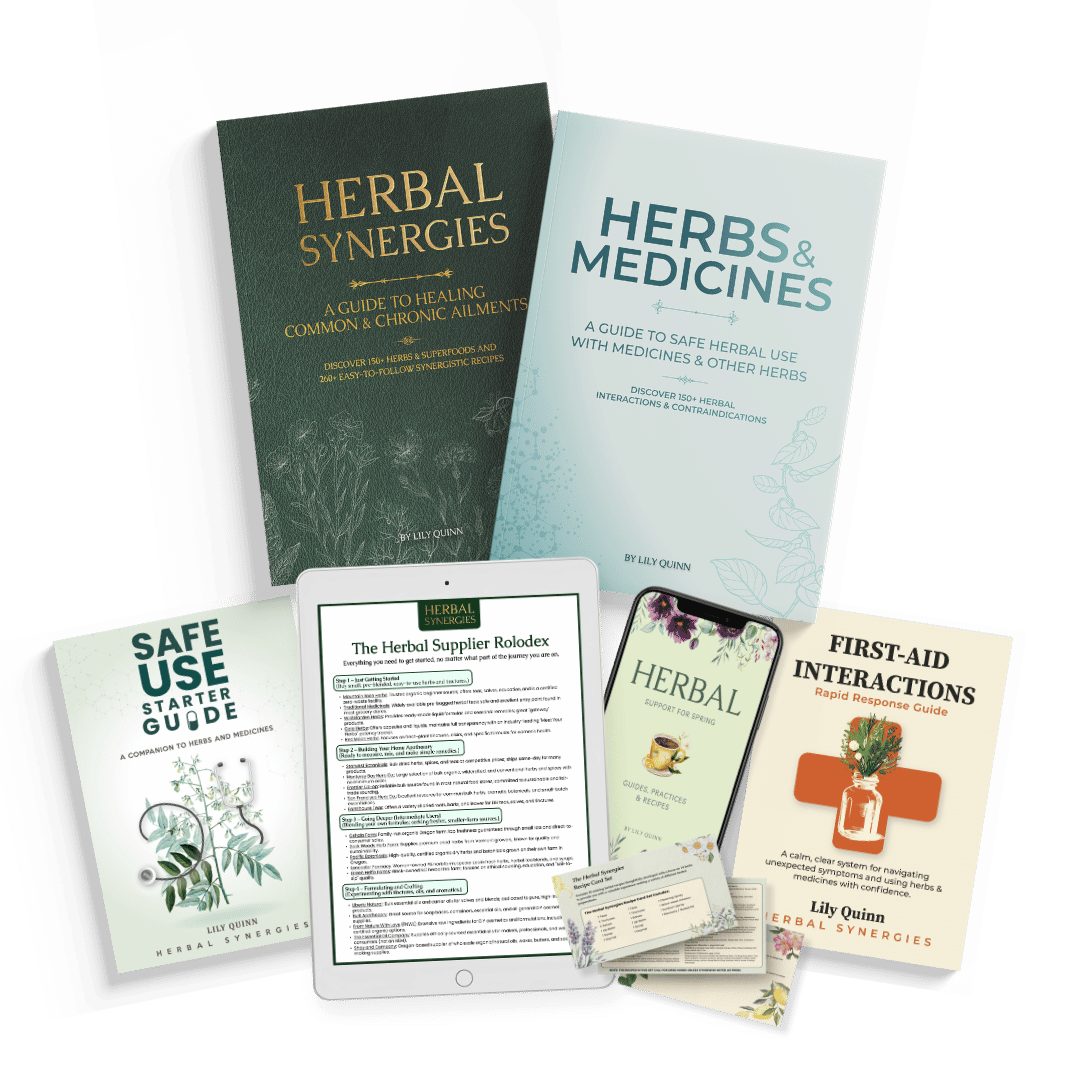
The green book tells you how herbs like comfrey have been used and how they work together; the blue book tells you what not to combine them with. Get both in the Herbal Synergies and Herbs & Medicines bundle, or start with Herbs & Medicines if safety is your first question.
Sources
- Memorial Sloan Kettering Cancer Center. Comfrey. About Herbs integrative medicine database. mskcc.org
- NCCIH. Kava. nccih.nih.gov/health/kava
- U.S. FDA. Mixing Medications and Dietary Supplements Can Endanger Your Health. fda.gov
Disclaimer: This article is for educational purposes only and is not intended to diagnose, treat, cure or prevent any disease. It is not a substitute for professional medical advice. Always consult your doctor or pharmacist before starting, stopping or combining any herb, supplement or medication. Statements about herbs have not been evaluated by the Food and Drug Administration.
This article is educational and is not a substitute for individualized medical or medication guidance from your physician, pharmacist, or other healthcare professional. Herbs can interact with medications and with each other; always confirm anything new with your provider. These statements have not been evaluated by the Food and Drug Administration.
How we research and review
Guides in the Herbal Reference Library draw on the same reference system as our books, which point to more than 500 scientific citations readers can check for themselves. Every recommendation is framed as support for everyday wellness, never as a treatment or a cure, and safety notes direct readers to confirm combinations with their own healthcare professional.
The Herbal Synergies Research Team compiles and reviews every guide in the Herbal Reference Library, drawing on published research, recognized herbal monographs, and current medication references. Our guides are written to support everyday wellness and always point you back to a qualified healthcare professional before you combine anything new.